
Creator commerce · Data contrast
Fast Push Game provides a setting for an instructional-design question: what would count as evidence that a viewer understood a demonstration? A teach-back exercise produces a checkable answer against product instructions, without treating reported sales as proof of comprehension.
Commerce performance: a sales report cannot score an instruction
Video units sold
10,000Rolling 90 daysReported video sales
$373,500Rolling 90 daysProducts promoted
220Rolling 90 daysVideo sales value per unit
$37.35Rolling 90 daysThe source reports 10,000 creator video-commerce units and $373,500 in creator video sales value for Fast Push Game. Those reported transactions do not contain a record of the actions a viewer can explain or perform. A teaching claim therefore needs a different observation: an answer checked against the actual product instructions.
The overview also records 220 distinct promoted products, 37,000 follower accounts and an aggregate $37.35 sales value per reported unit. None identifies a device’s rules, an instruction step or a comprehension error. It would be a category mistake to use any of these totals as a score for a demonstration.
The period in this creator-level overview applies to its reported sales, units and promoted-product count; followers are a separate snapshot. The separately displayed product records have their own scope: their periods and attribution to this creator are unverified, so they are not part of that period claim or evidence of this creator’s product-level sales.
The proposed exercise is deliberately narrower than a commercial performance test. It asks whether an explanation communicates a documented action accurately. It does not reconstruct Fast Push Game’s videos, claim any particular mechanics for its products, or explain the reported commerce results.
Your next step with VIKOC
Give your next idea a place to sell.
Create a VIKOC account, then start setting up your own storefront. Use the lessons here to make your offer clear to customers.
Already have an account? You can sign in on the next page.
The product-selling lesson: a demo that lets the buyer explain the rule
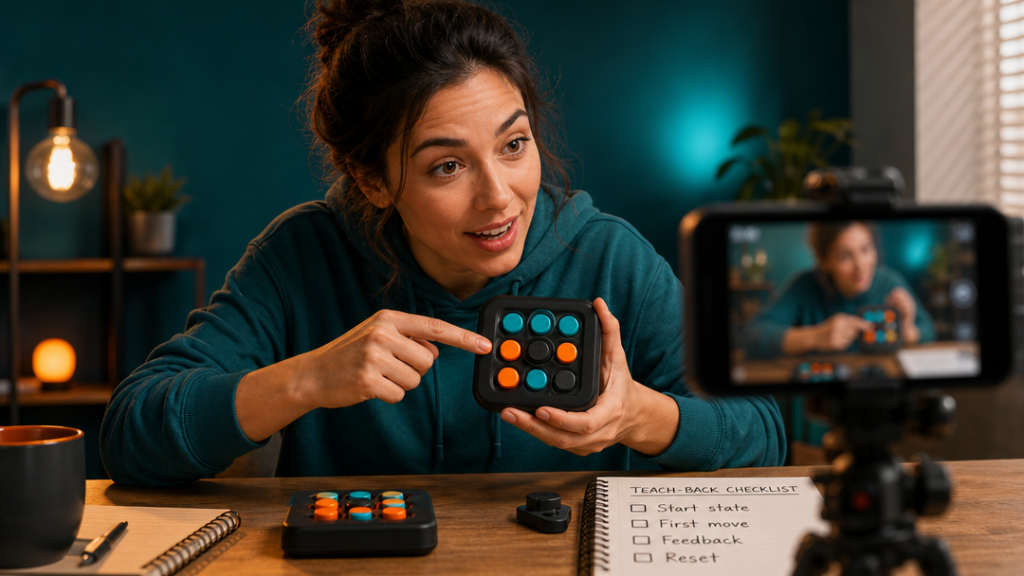
The proposed exercise is a teach-back: ask an unfamiliar participant to explain a demonstrated action in their own words, then compare the answer with verified product instructions. This is a content-comprehension test, not a claim about the mechanics of Fast Push Game’s products or its actual videos.
For a wholly fictional device, suppose the documented interaction has a start state, a permitted move, a feedback signal and a reset. A sample demonstration could show those four elements and then ask the participant to explain them. These are invented teaching examples.
For any real device, first obtain its instructions and replace the example with the actual documented steps; omit any step that the product does not have.
The practical difference from counting views is that the participant produces an answer that can be checked against an instruction. If the participant cannot describe a required action, that response identifies a point to investigate in the explanation. It does not establish that the product is poor or explain any creator’s commerce totals.
Products in focus
Leading products by recorded unit sales and sales value within the captured sample. These product totals are not attributed to this creator.

Highest reported unit sales in the captured sample
766,300 reported units sold
11,628,300 USD reported sales value
Source & sales scope
Product-level reported sales; creator attribution and observation period are unverified. Not creator GMV or income.
Observed 2026-11-13 15:10:10-08

Highest reported sales value in the captured sample
607,100 reported units sold
40,572,300 USD reported sales value
Source & sales scope
Product-level reported sales; creator attribution and observation period are unverified. Not creator GMV or income.
Observed 2026-11-13 15:10:10-08
Try this experiment: film a teach-back and log comprehension errors
Choose a game for which you can verify the manufacturer’s instructions. Write a checklist of the actions that those instructions actually require before making a clip; do not assume that the fictional start/move/feedback/reset example applies. Ask a colleague to check that the proposed demonstration follows that checklist.
Invite unfamiliar participants to watch and restate what they would do. Over a week, log whether each response matches the documented action and where participants are unsure. Keep unfamiliar terminology separate from a wrong action sequence. Review ambiguous answers with the participant rather than automatically recording them as errors.
Use the most frequent unresolved step to choose the next explanation to revise. Retest against the same documented instructions. A small or quiet sample is inconclusive, and an accurate explanation does not by itself predict a purchase. The output is a record of comprehension against a verified instruction set, not a claim about this creator’s actual game mechanics.
About the data
Sales and promoted products cover the recorded rolling 90-day period; followers are a separate snapshot. Sales are source-reported, not independently audited or creator earnings. USD uses the confirmed default where source currency is missing. The featured video illustrates the account; it has not been analyzed to explain sales.
- Video units sold: 10,000
- Source-labelled rolling 90 days. Captured 2026-11-13 15:11:29-08.
- Reported video sales: $373,500
- Source-labelled rolling 90 days. Captured 2026-11-13 15:11:29-08.
- Products promoted: 220
- Source-labelled rolling 90 days. Captured 2026-11-13 15:11:29-08.
- Video sales value per unit: $37.35
- Calculated from sales value divided by units sold in the same period. Source-labelled rolling 90 days. Captured 2026-11-13 15:11:29-08.
Updated November 16, 2026. Independent analysis; no creator endorsement implied.
Request a correction or removal


David A.
0 comment