
Creator commerce · Data contrast
juicy.fashion.apparel describes itself as viral TikTok trendy clothing. The commerce snapshot raises a practical question for any apparel seller: when a clothing claim depends on a label detail, how do you frame a label-verification test before turning that detail into a customer promise?
Commerce performance: a proposed label decision, not a proven sales lesson
Followers
76,700Follower snapshotVideo units sold
0Rolling 90 daysProducts promoted
487Rolling 90 daysReported video sales
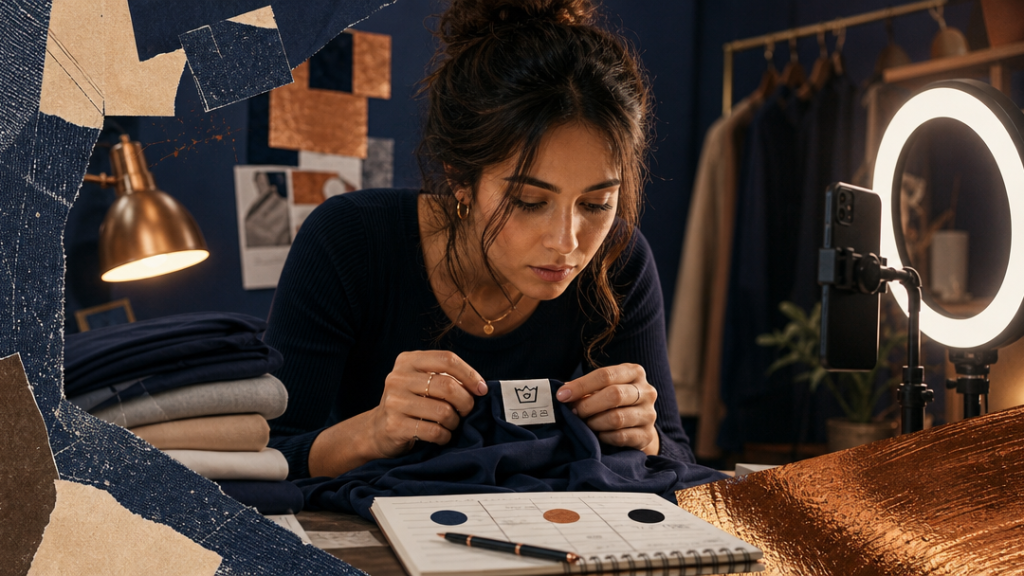
$0Rolling 90 daysConsider a hypothetical apparel creator whose bio says trendy clothing and who wants to say a garment is easy to care for. The safe decision is not to repeat that claim but to check whether a specific label instruction supports it. Imagine a garment label showing a cold-water wash symbol.
The question is whether the label documents a cold-water wash, a fact, or whether it promises color retention or durability, which it does not. If the label only shows cold-water wash, a care claim is not verified.
Now consider a counterexample: a viewer sees the same cold-water symbol in a garment they own, comments that the creator's explanation matches the label, and repeats the symbol. That comment shows the label instruction is recognizable to a viewer, not that the label proves the garment is easy to care for.
The decision rule is: if verified label instructions support the claim, state the instruction; if the label only supports a narrower instruction, state that narrower instruction and do not add a promise; if the label is not verified, abstain from the claim. This proposed decision is motivated only by the self-described profile theme, not by any observed sales outcome.
The snapshot provides context for the decision, but it does not resolve it. The profile reports 76,700 followers at capture. Within the 90-day window, the creator overview lists 487 distinct promoted products, while reported video commerce totals are 0 units and $0 in sales value.
These are a follower count, a promoted-product count and reported video-commerce totals; they do not establish the sales mix, purchases of any specific product or the label details of any garment. The commercial relevance is narrow: the snapshot does not tell a creator whether a specific garment claim would be supported by its label. That gap is the decision problem.
Label verification: test the claim before you make it
The proposed lesson is a label-verification test, not a sales fix. Before making a care claim in a video, the creator should read the garment's actual care label, identify the specific instruction it gives, and decide whether that instruction supports the sentence they plan to say. This is a suggested editorial method, not something juicy.fashion.apparel is known to do.
Use a hypothetical garment label that shows only a cold-water wash symbol. A sentence like 'this top is easy to care for because it can be washed cold' turns a documented washing instruction into a convenience claim. A label-verified sentence would be narrower: 'the label shows cold-water wash.' The first sentence asks the label to support a general benefit; the second reports only the instruction.
The test is to check whether the label can support the stronger sentence before it is written or spoken.
A useful counterexample: a label may show both a cold-water wash symbol and a do-not-bleach symbol. That combination supports a narrow care statement but still does not promise the garment will keep its color. The decision rule remains the same: match the sentence to the label, and when the label supports only part of the claim, drop the unsupported part or abstain.
This proposed test is motivated by the fast-fashion context, not by any claim about this creator's videos, inventory or results.
Your next step with VIKOC
Give your next idea a place to sell.
Create a VIKOC account, then start setting up your own storefront. Use the lessons here to make your offer clear to customers.
Already have an account? You can sign in on the next page.
Test the label decision with known correct answers
Run a short internal exercise before publishing a care claim. Take five garment labels, each with a documented instruction.
For each label, write a proposed sentence and classify it into one of three outcomes: supported if the sentence states only the documented instruction; narrower if the sentence must be cut back to the instruction; abstain if the label does not support the sentence and no instruction can be stated. Do not publish the sentences; this is a decision test, not a content performance test.
Record the classification for all five labels and note the number of supported, narrower and abstain outcomes. A result of three or more supported sentences means the claim-writing process is working; two or more abstains means the proposed sentences are outrunning the labels and the wording should be tightened before any claim is made. A single narrower outcome is not a failure; it shows the label set a boundary.
This exercise tests the proposed decision directly because the correct answer is determined by the label, not by audience response. It does not guarantee sales, engagement or viewer understanding, and it does not assume that this creator uses label verification. The next step is to repeat the exercise with a second set of labels and compare the classification mix.
If narrow or abstain outcomes recur, the practical conclusion is to write shorter, label-matched sentences; if supported outcomes recur, the method is ready to guide future claim wording.
About the data
Sales and promoted products cover the recorded rolling 90-day period; followers are a separate snapshot. Sales are source-reported, not independently audited or creator earnings. USD uses the confirmed default where source currency is missing. No usable video link accompanies this archived sample; no video content analysis was used.
- Followers: 76,700
- Point-in-time snapshot. Captured 2026-11-12 06:14:55-08.
- Video units sold: 0
- Source-labelled rolling 90 days. Captured 2026-11-12 06:14:55-08.
- Products promoted: 487
- Source-labelled rolling 90 days. Captured 2026-11-12 06:14:55-08.
- Reported video sales: $0
- Source-labelled rolling 90 days. Captured 2026-11-12 06:14:55-08.
Updated November 18, 2026. Independent analysis; no creator endorsement implied.
Request a correction or removal
David A.
0 comment