
The short answer
Price a digital product by defining its scope, estimating the costs that change with each sale, comparing genuinely similar offers and choosing a test price you can explain. Cost-recovery arithmetic is useful, but it is not a demand forecast.
Start with a defined version
Before choosing a price, define the offer. Our example is a three-design café poster pack with PNG artwork, editable SVG files, and basic opening instructions. It does not include custom edits.
A standard download and a personalized service should not share an unexplained price because the work is different. Write down the scope and the support you intend to provide. Otherwise, you might set a price for a small file pack while accidentally promising hours of individual help.
Calculate an illustrative contribution
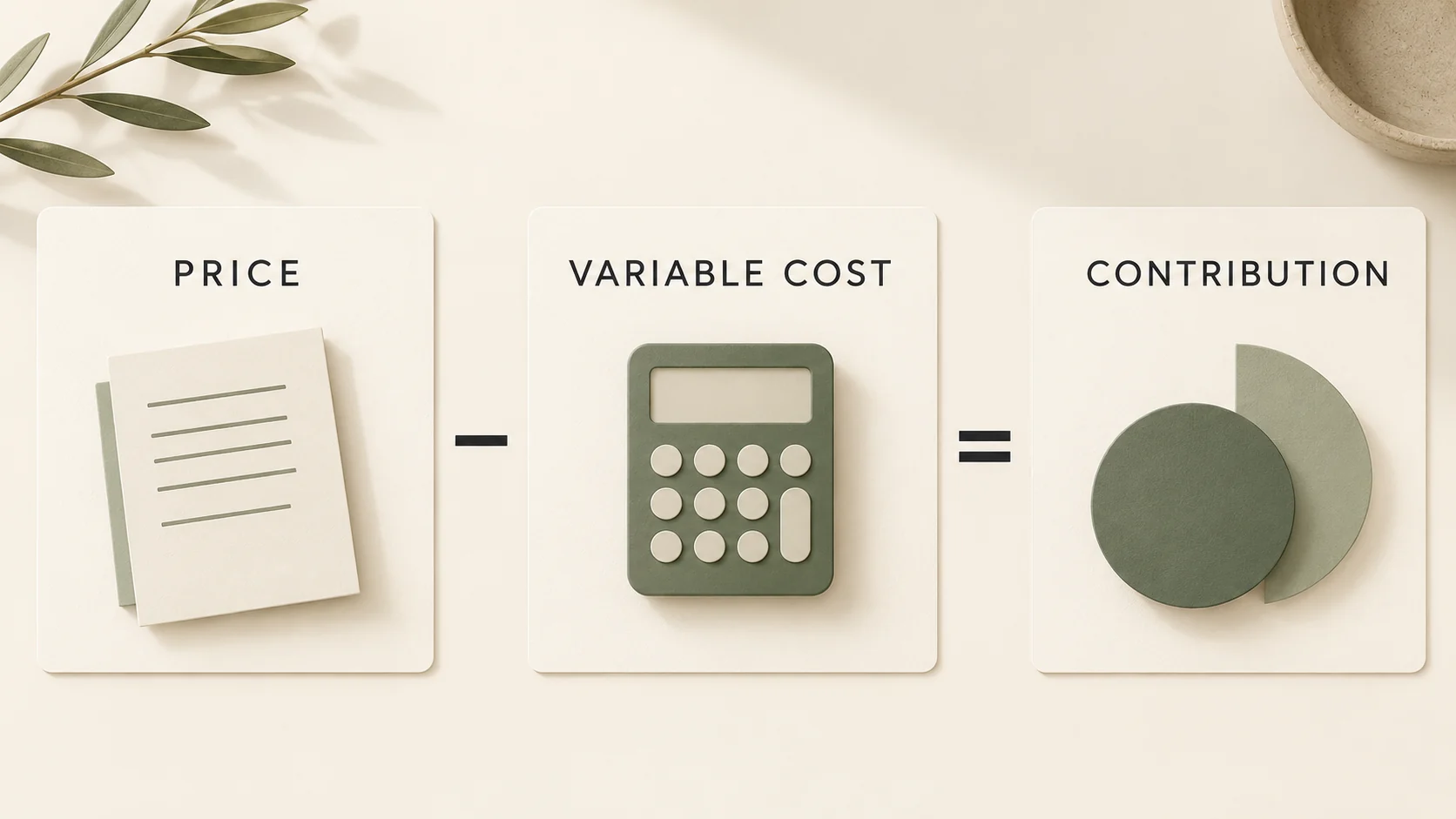
Suppose the pack sells for twelve dollars. For this exercise only, assume variable platform and processing charges total one dollar per order, and expected support costs another dollar. That leaves ten dollars per sale before recovering creation costs, fixed expenses, taxes, refunds, or other costs.
We are choosing round assumptions to explain the calculation; these are not quoted VIKOC or payment-provider rates. Replace every assumption with the costs applicable to your own account. The useful formula is price minus the costs that change with each sale.
Recover the initial work without assuming demand
Now suppose creating and testing the pack represents two hundred dollars of initial cost. At ten dollars contribution per sale, recovering that two hundred dollars would require twenty sales, before the other costs we excluded. This is arithmetic, not a forecast that twenty customers will appear.
If you lower the example price to eight dollars while keeping two dollars of variable costs, contribution becomes six dollars. Recovering two hundred dollars then requires thirty-four whole sales. A lower price can change the workload needed to recover the same investment.
Compare value and alternatives fairly
Costs give you one boundary, but they do not tell you what buyers find worthwhile. Compare offers aimed at the same buyer and task. A pack of flattened images is not equivalent to an editable pack with clear instructions.
A custom design service is another category again. Inspect the preview quality, scope, license, and support before treating two prices as comparable. Talk to potential buyers about their current approach and what is missing.
Do not turn an enthusiastic comment into proof of willingness to pay.
Choose a test price and a review rule
Select an initial price that fits the defined offer and the evidence you have. Record why you chose it and when you will review it. Look at qualified visits, questions, purchases, and support demands together.
Few sales from a tiny or irrelevant audience do not isolate a pricing problem. Before discounting, check the product promise, preview, and visitor source. When you do change a price, document the change so you can interpret later results.
Avoid changing the product, audience, and price simultaneously if you want to learn from the test.
A worked pricing example
These are hypothetical inputs, not VIKOC fees or a sales forecast. Creation cost is $200; variable cost is $2 per order. Other fixed costs, taxes and refunds are excluded.
| Price | Contribution per sale | Whole sales to recover $200 |
|---|---|---|
| $12 | $12 − $2 = $10 | 20 |
| $8 | $8 − $2 = $6 | 34 |
Try it with one real offer
Using illustrative assumptions only, calculate contribution at a $12 price with $2 variable cost: $10 per sale. A $200 creation cost would require 20 sales to recover before other expenses. Replace the assumptions with your own costs.
Common questions
Is contribution the same as profit?
No. Price minus variable cost leaves an amount toward creation costs and other fixed expenses. Taxes, refunds and other costs may still reduce the final result.
Should I lower the price after a few visits without sales?
Not automatically. A small or irrelevant sample cannot isolate a price problem. Check the traffic source, offer clarity and preview before changing several variables at once.