
Creator commerce · Data contrast
treytintinger runs a TikTok Shop finds profile that self-describes in the supplements space. The commerce question is not how large the sales footprint is but whether a pack price can be sold as a cost-per-use decision at all, or whether the missing pack quantity and serving instructions make that claim premature.
Commerce performance: the pack-price decision before any worksheet
Followers
101,500Follower snapshotVideo units sold
13,100Rolling 90 daysProducts promoted
73Rolling 90 daysReported video sales
$328,900Rolling 90 daysVideo sales value per unit
$25.11Rolling 90 daysConsider a hypothetical creator selling a supplement through short videos. The offer shows a pack price. A cost-per-serving comparison needs the payable pack price and a documented number of servings per pack. Estimating a replacement interval is a separate calculation that also needs an explicit use-frequency assumption. Pack price alone cannot answer either question.
It is a label without the information needed for that comparison.
The snapshot shows meaningful reported commerce activity, but it does not identify the product-level decision behind it. In the source-reported rolling 90-day window, the creator's reported video commerce totals $328,900 in sales value against 13,100 units. The profile also shows 73 distinct promoted products and 101,500 followers.
That combination is consistent with a broad reported promotion footprint, not proof that one supplement drove the result or that the audience prefers a particular pack size.
The aggregate ratio of $25.11 per reported unit is useful as a description of the combined record, but it cannot set the price, affordability or expected order value of a specific supplement. Sales value is not earnings, and promoted-product count does not show how sales were distributed across products.
Archived category labels are not a sales-category mix, and the totals do not establish actual purchases of any specific item.
The bounded commercial decision is therefore whether one documented consumable offer can support a clearer buying comparison. A creator should not use the aggregate record to promise a restock rhythm or to infer a typical supplement price. The next video can instead test whether pack quantity and serving instructions give buyers enough information to evaluate the offer.
Your next step with VIKOC
Give your next idea a place to sell.
Create a VIKOC account, then start setting up your own storefront. Use the lessons here to make your offer clear to customers.
Already have an account? You can sign in on the next page.
The supplement cost-per-use test starts with what the label states
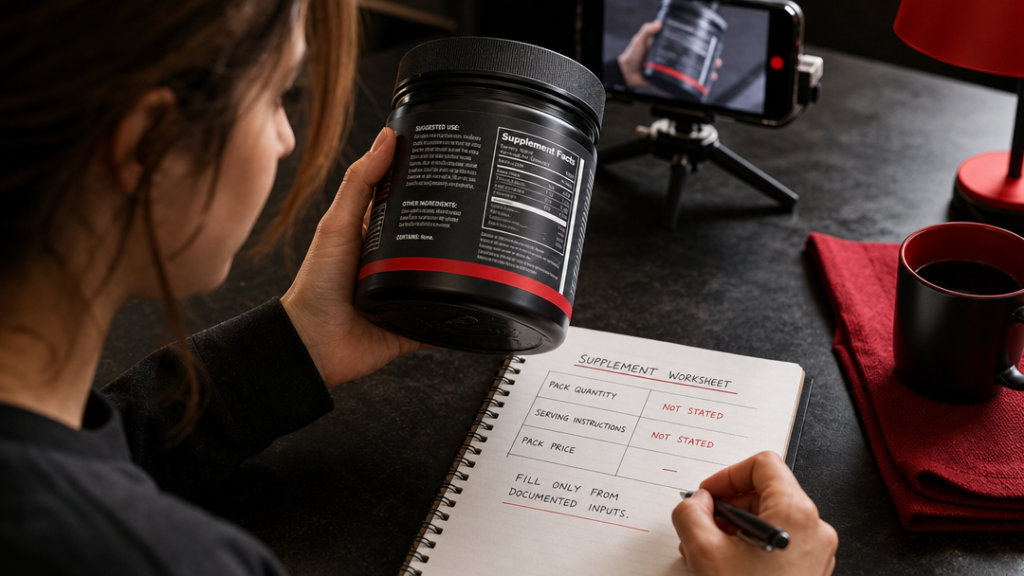
Here is a proposed lesson, not a description of anything this creator has done. If a pack price is the hook, the first job is to confirm that the pack quantity and serving instructions needed to turn it into cost per use exist in writing. When they do, the arithmetic is straightforward: the payable pack price divided by documented servings per pack gives cost per serving.
When they do not, the honest move is to identify the missing input rather than estimate it.
The practical consequence is that some offers cannot yet support a restock message. Net weight alone does not establish servings. A stated mass per serving and a comparable net mass may support a calculation, while an unspecified scoop volume may not. Check whether the documented units are compatible before calculating; otherwise leave the missing input unresolved. Those are listing gaps, not failures of the product.
This distinction matters because pack price, cost per serving and a replacement interval answer different questions. A lower pack price need not mean a lower cost per documented serving. These calculations do not establish equivalent products, benefits or an appropriate personal use pattern.
The lesson is to keep the claim inside the label: what the pack states, what it does not, and what arithmetic those inputs permit.
Publish one worksheet and record which input buyers ask about
Action to try: pick one supplement offer and build a single-page worksheet with three labeled fields, pack quantity, serving instructions and pack price, filled only from documented inputs. Where a field is missing, write 'not stated' rather than estimating. Present the worksheet as an arithmetic exercise on the label, not as advice about what to take.
Record the responses by which missing or present input buyers mention. Tally how many ask about servings per pack, how many ask how often to replace the pack, and how many ask about a different pack size. Note separately any buyer who asks only to compare the pack price with another product.
Use a fixed criterion. If most classifiable responses mention pack quantity or replacement interval, the worksheet is surfacing the decision and the next explanation should walk through the stated arithmetic product by product.
If most mention only price comparisons with no reference to quantity, that feedback alone does not establish what the audience understands; the next explanation could make the denominator explicit and ask readers to explain the comparison. If responses are too few to classify, the format is inconclusive and should be repeated before any restock framing is used.
None of these outcomes guarantees sales; each changes what the next video is allowed to claim.
About the data
Sales and promoted products cover the recorded rolling 90-day period; followers are a separate snapshot. Sales are source-reported, not independently audited or creator earnings. USD uses the confirmed default where source currency is missing. No usable video link accompanies this archived sample; no video content analysis was used.
- Followers: 101,500
- Point-in-time snapshot. Captured 2026-11-13 03:08:56-08.
- Video units sold: 13,100
- Source-labelled rolling 90 days. Captured 2026-11-13 03:08:56-08.
- Products promoted: 73
- Source-labelled rolling 90 days. Captured 2026-11-13 03:08:56-08.
- Reported video sales: $328,900
- Source-labelled rolling 90 days. Captured 2026-11-13 03:08:56-08.
- Video sales value per unit: $25.11
- Calculated from sales value divided by units sold in the same period. Source-labelled rolling 90 days. Captured 2026-11-13 03:08:56-08.
Updated November 18, 2026. Independent analysis; no creator endorsement implied.
Request a correction or removal


David A.
0 comment