
Creator commerce · Data contrast
kaleyreed_ describes a cozy-home, daily-finds account. Her reported video commerce raises a specific commercial decision for any home-focused seller: before you promote a single home item, how do you judge whether it will actually fit the space a viewer pictures? A paper footprint mock-up is a cheap screening step, but it only earns its place if you define what a pass or fail would change.
Commerce performance: the fit-check decision behind a broad promoted catalog
Followers
35,200Follower snapshotVideo units sold
4,703Rolling 90 daysProducts promoted
55Rolling 90 daysReported video sales
$204,600Rolling 90 daysVideo sales value per unit
$43.50Rolling 90 dayskaleyreed_'s bio positions the account around cozy home, mom life and daily finds. That self-description suggests a plausible reader problem: a home item has to fit a specific shelf, counter or entryway, and a viewer has to picture it in their own space. The commercial decision is not whether home items sell in the abstract.
It is whether a fit-check content piece should come before promoting a single item, because the fit-check can fail in ways the item itself cannot: the packaged dimensions may not match the installed footprint, and the clearance needed to open a drawer or reach a handle may overlap the counter edge.
This is a proposed screening logic, not evidence that the creator used it or that fit was the reason for any reported sale.
The 90-day snapshot behind that decision is aggregate only. Followers were 35,200; reported video units were 4,703; reported video sales value was $204,600; and the account promoted 55 distinct products. The derived sales value per reported unit is $43.50, an aggregate ratio, not a typical item price or order value.
Read together, the figures show commerce activity across a catalog whose product-level contribution is unresolved: the unit and sales totals cannot identify whether a few products drove the result or whether activity was distributed across the promoted set. Archived category labels are not a sales-category mix, and these totals do not establish actual purchases of any specific product.
That unresolved product-level question makes the fit-check a bounded reader decision rather than a conclusion about the account's performance. A seller can use it to decide whether one item's placement is clear enough to explain before spending content time on it.
If the dimensions or clearance cannot be demonstrated, the seller has a reason to postpone that item; if they can, the test still has to earn attention through audience response.
Your next step with VIKOC
Give your next idea a place to sell.
Create a VIKOC account, then start setting up your own storefront. Use the lessons here to make your offer clear to customers.
Already have an account? You can sign in on the next page.
A footprint mock-up that can pass, fail or abstain
Proposed lesson, explicitly hypothetical: use a paper footprint mock-up as a go/no-go screen for one home item before you promote it. The point is not to prove the item will sell. The point is to decide whether you can explain its fit honestly in a short clip, or whether the fit is too ambiguous to lead with.
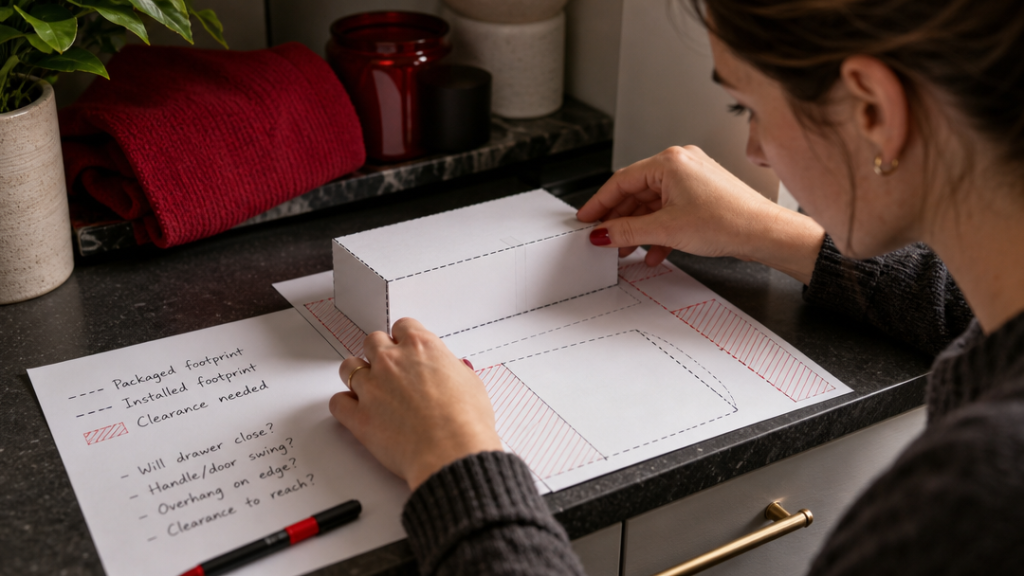
Cut paper to the dimensions available from the seller, place it on the intended shelf or counter, and mark three things separately: the packaged footprint, the installed footprint, and the clearance needed to open, use or move around the item. Photograph each stage.
Imagine a small countertop organizer: the box might fit in a drawer, but the installed piece could crowd a kettle, and the clearance to open a lower cabinet could overlap the counter edge. Those are different constraints, and a paper cut-out surfaces the conflict before you film.
The decision rule is what makes the exercise useful. Pass if all three measurements fit the intended placement with clearance to spare, and you can state the numbers on camera without hedging. Fail if any measurement overlaps a fixed object or blocks clearance, and no alternative placement works.
Abstain if the seller's listed dimensions are missing or ambiguous, or if the only placement you can test is not the one you would show. A pass opens a fit-check clip; a fail means pick a different item or a different room; an abstain means gather dimensions before spending content time.
These conditions test the decision because each one maps to a different next action—promote, skip or postpone—rather than to a generic verdict about the item.
Run the screen, record the fit questions, then explain
Pick one hypothetical home item you are considering. Make the paper mock-up, photograph the packaged footprint, installed footprint and clearance, and apply the pass/fail/abstain rule you wrote down before filming. Then publish one short clip that walks through the fit check, not just the item.
Record a task-specific response: saves, and comments that ask about dimensions, counter space or clearance—not general praise. Also note which fit question your clip did not answer. If fit questions dominate, lead the next explanation with the measurements that were missing; if viewers ask about a placement you did not test, add that scenario to the next mock-up.
If those responses do not appear, the fit-check premise has not earned another content slot yet; test a different explanation or item instead. Either response changes the explanation, not the item's sales guarantee—and neither is a reason to diagnose inventory or sourcing from comments.
About the data
Sales and promoted products cover the recorded rolling 90-day period; followers are a separate snapshot. Sales are source-reported, not independently audited or creator earnings. USD uses the confirmed default where source currency is missing. No usable video link accompanies this archived sample; no video content analysis was used.
- Followers: 35,200
- Point-in-time snapshot. Captured 2026-11-12 08:21:06-08.
- Video units sold: 4,703
- Source-labelled rolling 90 days. Captured 2026-11-12 08:21:06-08.
- Products promoted: 55
- Source-labelled rolling 90 days. Captured 2026-11-12 08:21:06-08.
- Reported video sales: $204,600
- Source-labelled rolling 90 days. Captured 2026-11-12 08:21:06-08.
- Video sales value per unit: $43.50
- Calculated from sales value divided by units sold in the same period. Source-labelled rolling 90 days. Captured 2026-11-12 08:21:06-08.
Updated November 18, 2026. Independent analysis; no creator endorsement implied.
Request a correction or removal


David A.
0 comment