
Creator commerce · Data contrast
dealswithty's bio describes the profile as a place to check deals, which raises a concrete decision for any deal-led seller: before calling two offers comparable, separate what each discount is measured against from what the buyer actually receives. The snapshot records substantial video-commerce activity across a broad promoted-product count, but it cannot show which offer drove it or establish a product-level price comparison. That makes input quality—not the aggregate total—the useful next question.
Commerce performance and the comparability decision
Followers
165,900Follower snapshotVideo units sold
7,548Rolling 90 daysProducts promoted
133Rolling 90 daysReported video sales
$2,007,500Rolling 90 daysVideo sales value per unit
$265.96Rolling 90 daysPicture a deal-led seller planning two promotions for one week of videos and wanting to tell a returning buyer they are the same kind of deal. That is a hypothetical reader problem, motivated only by the profile's self-described deal-showcase line, not something this creator is shown doing.
The decision depends on three things a commerce total cannot supply: the baseline each discount is measured against, the final amount payable, and the quantity the buyer receives.
The snapshot establishes activity, not a product-level answer. It reports 165,900 followers, 7,548 video units and $2,007,500 in video sales value over the 90-day window, alongside 133 distinct promoted products. The aggregate ratio of $265.96 per reported unit can describe the totals' relationship, but it cannot identify a typical item price, an order value, or which products generated the activity.
A practical consequence follows: do not use the snapshot to choose a winning offer or claim that one deal format caused the recorded sales. Use it to set a narrower information test—can the specific offers under consideration be compared from their own stated inputs?
Here is a concrete counterexample with invented figures. In this fictional example, an offer advertises a larger percentage reduction for a single item, while another advertises a smaller reduction for a bundle. The percentages alone cannot rank the amount paid per item. A comparison first needs each final payable price and included quantity, alongside the reference price behind each advertised reduction.
If these inputs are missing, leave that comparison unresolved. The broad promoted-product count also makes product-level attribution especially important: it does not reveal whether activity was spread across the products or concentrated in a smaller subset.
Your next step with VIKOC
Put a clear offer behind your expertise.
Create a VIKOC account, then prepare your product and its price. Apply this guide to an offer your customers can understand.
Already have an account? You can sign in on the next page.
The discount question: build test pairs with known answers
For this proposed exercise, distinguish the question being answered: the advertised percentage reduction, the cash saving against a stated baseline, or the final payable amount per included item. These comparisons use different denominators. They should not be treated as interchangeable.
Construct fictional offer cards with explicit baseline, final payable amount, and included quantity. Keep the item specification and any conditions visible. A card with a larger advertised percentage can still have a higher final cost per comparable item. Conversely, a bundle can have a lower unit cost while requiring a larger total payment. Neither label alone decides which offer suits a buyer.
A proposed practice is to label the comparison question before calculating. If the necessary inputs are supplied and item specifications are comparable, calculate that measure. If quantity, payable price or conditions are missing, mark that measure unresolved and request the missing input.
If the proposed offers come from different products or materially different quantities, do not turn a numerical difference into a claim that one is the better deal. This is an editorial exercise, not evidence of dealswithty's actual offers or a legal pricing assessment.
Run the mock decision on paper first
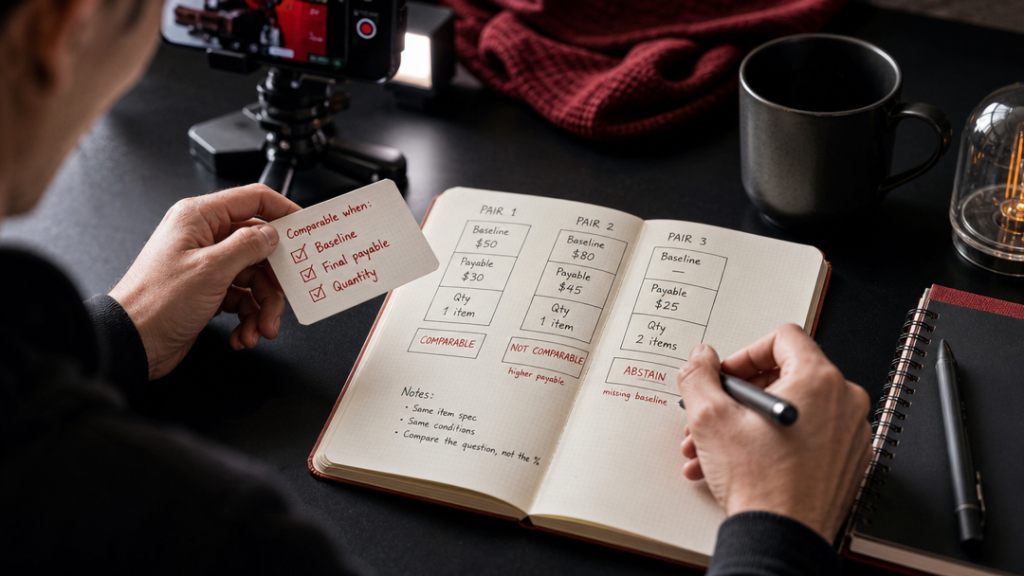
Write three invented offer pairs, each with a stated or deliberately missing baseline, final payable amount and quantity. Beside each pair write the correct label before you describe any real offer: comparable, not comparable, or abstain.
A pair earns comparable only when baseline, payable amount and quantity are stated and the item specifications match; not comparable only when the relevant inputs are known and the offers differ in a way that answers the chosen question; if a required input is missing, the only correct answer is abstain.
Record which pairs you mislabeled and on which line, baseline, payable amount or quantity. If you reached the correct label on at least two of three, your next move is to copy the three-input format onto one draft offer and check that a second reader reaches the same label from the draft alone. If you missed more than one, rebuild the pair and reach the correct label twice before adding a discount to any content.
What you record is your own test accuracy, not audience behavior, so no reader response is guaranteed—only that the claim is defensible on the page.
About the data
Sales and promoted products cover the recorded rolling 90-day period; followers are a separate snapshot. Sales are source-reported, not independently audited or creator earnings. USD uses the confirmed default where source currency is missing. The featured video illustrates the account; it has not been analyzed to explain sales.
- Followers: 165,900
- Point-in-time snapshot. Captured 2026-11-14 03:47:53-08.
- Video units sold: 7,548
- Source-labelled rolling 90 days. Captured 2026-11-14 03:47:53-08.
- Products promoted: 133
- Source-labelled rolling 90 days. Captured 2026-11-14 03:47:53-08.
- Reported video sales: $2,007,500
- Source-labelled rolling 90 days. Captured 2026-11-14 03:47:53-08.
- Video sales value per unit: $265.96
- Calculated from sales value divided by units sold in the same period. Source-labelled rolling 90 days. Captured 2026-11-14 03:47:53-08.
Updated November 18, 2026. Independent analysis; no creator endorsement implied.
Request a correction or removal
David A.
0 comment