
Creator commerce · Data contrast
bysabrinajoy's bio describes shapewear and curvy-girl try-ons, but the available commerce record cannot identify her selling method, winning product or audience conversion. It does show reported video-commerce activity across a broad promoted-product count. For another creator selling fit-sensitive apparel, the practical decision is whether a repeatable sizing explanation is worth testing on one item before scaling it.
Commerce performance: what this snapshot can—and cannot—decide
Followers
40,900Follower snapshotVideo units sold
6,943Rolling 90 daysProducts promoted
112Rolling 90 daysReported video sales
$262,700Rolling 90 daysVideo sales value per unit
$37.84Rolling 90 daysStart with the bounded decision, not an assumed workflow. The available record cannot show whether bysabrinajoy uses tape measurements, which item sold, how many videos mentioned it, or whether a sizing explanation influenced a purchase. Her bio supplies the fit-sensitive apparel context, while the commerce observations supply scale and breadth—not a proven content method.
In the verified 90 days the source reports 6,943 video units and $262,700 in attributed video sales value, alongside a profile count of 40,900 followers. The overview also lists 112 distinct promoted products, and the aggregate ratio works out to $37.84 in sales value per reported unit.
That combination makes a small information-design test commercially reasonable, but not proven necessary. Reported units and sales value show purchase activity attributed to video commerce; they do not reveal buyers, conversion, profit or the contribution of any one garment. The product count indicates breadth, not a sales mix or a reason to promote more products.
The ratio is a blended aggregate, not a typical item price or order value. The useful question is therefore whether a clearer sizing explanation earns a place in the selling process for one selected item—not whether this snapshot proves that measurement content caused the recorded activity.
Turn the fit question into a product-selling test
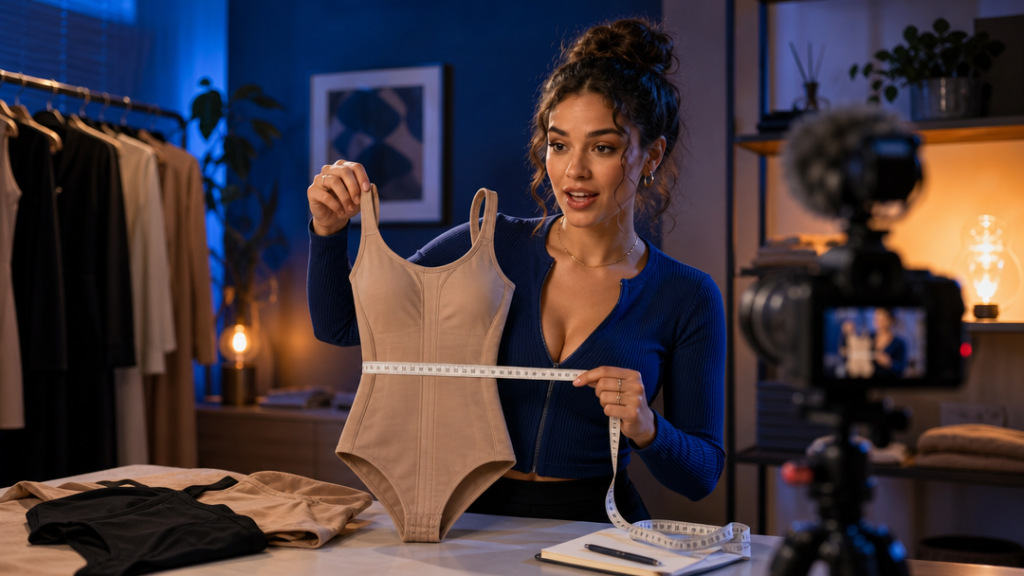
The counterexample is worth stating plainly. Imagine two try-on videos for the same bodysuit. The first says it runs small and looks great. The second says the waist measures, say, a garment laid flat with the tape at the narrowest point, in inches, with the garment unworn; the viewer is told to take the same reading on their own waist standing relaxed. The first asks for trust.
The second gives the viewer something to compare.
That difference is a proposed test for creators selling fit-sensitive apparel, not an account of what bysabrinajoy does. The snapshot cannot establish that this method would improve sales.
Its value is that it produces a falsifiable content decision: if people cannot repeat the instruction, or if the added detail does not improve the chosen selling signal against a comparable post, the method should not be scaled merely because the category feels measurement-sensitive.
The same card also constrains the creator's own language. If every garment is described using the same stated baseline, units and posture, two items can be compared without implying that one person's fit predicts another's. The commercial value is potential reuse: one explanation template that travels across items instead of a fresh guess per video.
Your next step with VIKOC
Give your next idea a place to sell.
Create a VIKOC account, then start setting up your own storefront. Use the lessons here to make your offer clear to customers.
Already have an account? You can sign in on the next page.
Test whether the method reproduces before scaling it
Pick one garment and publish the sizing explanation twice, in two separate videos, using the identical wording for tape location, garment-versus-body baseline, units and posture. Do not change the method between posts.
Then measure, with a tape, the same garment yourself both times and record whether the two readings agree exactly, agree within a small stated margin you name in advance, or disagree. Ask a second person to repeat the written instructions and record the same three outcomes.
The pass condition is that both your repeat and the second person's reading land inside your pre-stated margin; a fail is any reading outside it; abstain if the person needed to ask what the instruction meant, because ambiguity blocks reproduction before accuracy does.
These conditions test the proposed information method, not whether the original commerce snapshot was caused by sizing content. If the method passes, compare the two posts using the selling signal available to the creator before deciding whether to reuse it. If it fails, fix the ambiguous instruction or drop the method; do not treat aggregate sales or units as proof that the explanation worked.
About the data
Sales and promoted products cover the recorded rolling 90-day period; followers are a separate snapshot. Sales are source-reported, not independently audited or creator earnings. USD uses the confirmed default where source currency is missing. No usable video link accompanies this archived sample; no video content analysis was used.
- Followers: 40,900
- Point-in-time snapshot. Captured 2026-11-13 11:30:01-08.
- Video units sold: 6,943
- Source-labelled rolling 90 days. Captured 2026-11-13 11:30:01-08.
- Products promoted: 112
- Source-labelled rolling 90 days. Captured 2026-11-13 11:30:01-08.
- Reported video sales: $262,700
- Source-labelled rolling 90 days. Captured 2026-11-13 11:30:01-08.
- Video sales value per unit: $37.84
- Calculated from sales value divided by units sold in the same period. Source-labelled rolling 90 days. Captured 2026-11-13 11:30:01-08.
Updated November 18, 2026. Independent analysis; no creator endorsement implied.
Request a correction or removal



David A.
0 comment