

Creator commerce · Data contrast
Real_Men_Apparel_Company raises a practical question for apparel sellers: when audience size is only a starting point, what can reported commerce activity reveal—and which product-fit explanation is worth testing next?
Commerce performance: audience size becomes more useful beside buying activity
Followers
86,400Follower snapshotVideo units sold
829Rolling 90 daysProducts promoted
64Rolling 90 daysReported video sales
$35,000Rolling 90 daysVideo sales value per unit
$42.22Rolling 90 daysFor a product creator, the commercial question is not only how many people are following. It is whether the available record shows measurable movement toward a purchase. The profile snapshot reports 86,400, while the rolling commerce record reports 829 and $35,000.
That combination adds something an audience snapshot cannot: reported video-commerce activity. It gives another creator a concrete signal to study when deciding whether to plan content around reach alone or around a measurable product action. It does not identify unique buyers, earnings, profit or the reason individual shoppers purchased.
But it moves the assessment beyond potential audience and toward observed commercial activity.
The same overview records 64 as the distinct promoted-product count. This is a breadth measure, not evidence that every item sold, appeared in a particular video or contributed equally to the reported result. The aggregate ratio of $42.22 can describe the scale of recorded sales value relative to recorded units in that period.
It should not be read as a typical apparel price, order value, affordability measure or profit figure.
The useful gap is therefore clear: the record shows that buying activity exists, but not what product explanation or content choice produced it. That is where a creator-facing experiment can add learning.
Make the product-fit decision easy to check
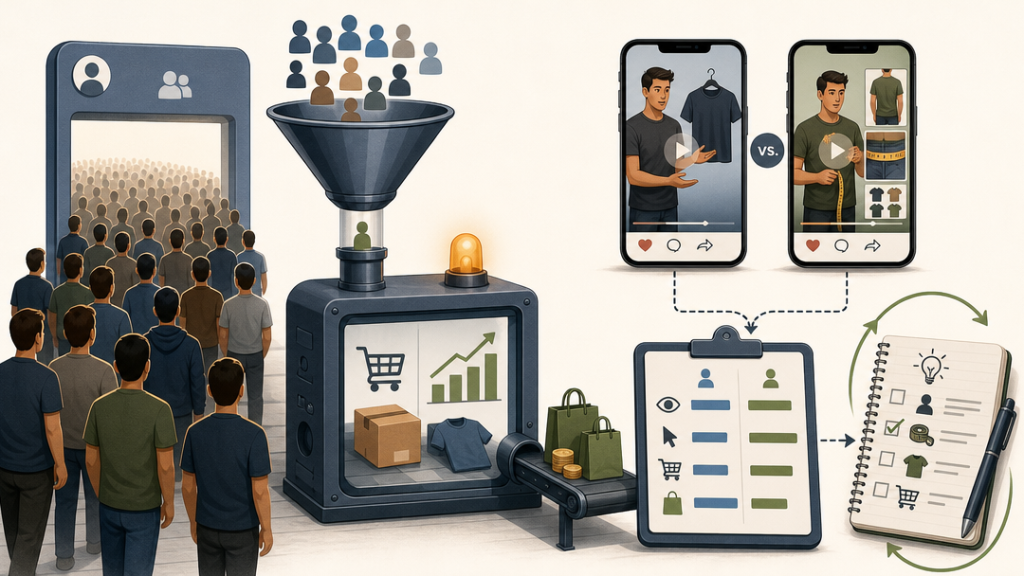
A useful hypothesis for apparel sellers is that content becomes more commercially helpful when it answers the buyer’s selection question directly. This is a proposed lesson to test, not a documented explanation of Real_Men_Apparel_Company’s results; the available record does not analyze its videos or item-level sales.
Imagine a shopper who is unsure which item or option is right for them. A focused explanation could cover four points: who the product is designed for, which fit or comfort problem it addresses, how the shopper should choose the relevant size or option, and where to take the next step. Each point should be verifiable from the product information rather than relying on a vague promise.
For example, an apparel creator might demonstrate where a garment is intended to sit, identify the measurement the shopper should check, and show how that measurement maps to the available options. The point is not to claim that a demonstration guarantees conversion. It is to turn an unclear buying decision into a checklist the viewer can use.
This structure also gives the creator a sharper content choice. A broad product mention asks attention to do the selling. A fit-focused explanation gives the viewer a reason to assess the item and creates a specific hypothesis about what the content is helping them decide.
Run a quiet two-version test and log the buying response
Select one apparel product and film two comparable pieces of content. Version A should introduce the product broadly. Version B should answer the buying checklist: intended customer, fit or comfort problem, selection guidance and purchase path. Keep the product, destination and offer consistent so the explanation is the main difference.
Publish the versions within a similar seven-day period and record exposure, product-page visits, clicks, add-to-cart activity, units sold and sales value for each. Also log substantive viewer questions, especially questions about fit, sizing or choosing between options. Those questions are clues for the next explanation, not proof of demand by themselves.
After the observation period, compare purchase actions relative to exposure rather than relying only on raw totals. If the fit-focused version produces a clearer buying response, make that explanation the foundation for the next script and test a different buyer concern.
If the result is quiet or mixed, do not treat it as a reason to change inventory immediately; revise one part of the explanation or purchase path and run a cleaner follow-up.
About the data
Sales and promoted products cover the recorded rolling 90-day period; followers are a separate snapshot. Sales are source-reported, not independently audited or creator earnings. USD uses the confirmed default where source currency is missing. The featured video illustrates the account; it has not been analyzed to explain sales.
- Followers: 86,400
- Point-in-time snapshot. Captured 2026-10-28 06:03:12-07.
- Video units sold: 829
- Source-labelled rolling 90 days. Captured 2026-10-28 06:03:12-07.
- Products promoted: 64
- Source-labelled rolling 90 days. Captured 2026-10-28 06:03:12-07.
- Reported video sales: $35,000
- Source-labelled rolling 90 days. Captured 2026-10-28 06:03:12-07.
- Video sales value per unit: $42.22
- Calculated from sales value divided by units sold in the same period. Source-labelled rolling 90 days. Captured 2026-10-28 06:03:12-07.
Updated November 3, 2026. Independent analysis; no creator endorsement implied.
Request a correction or removal



David A.
0 comment