
Creator commerce · Data contrast
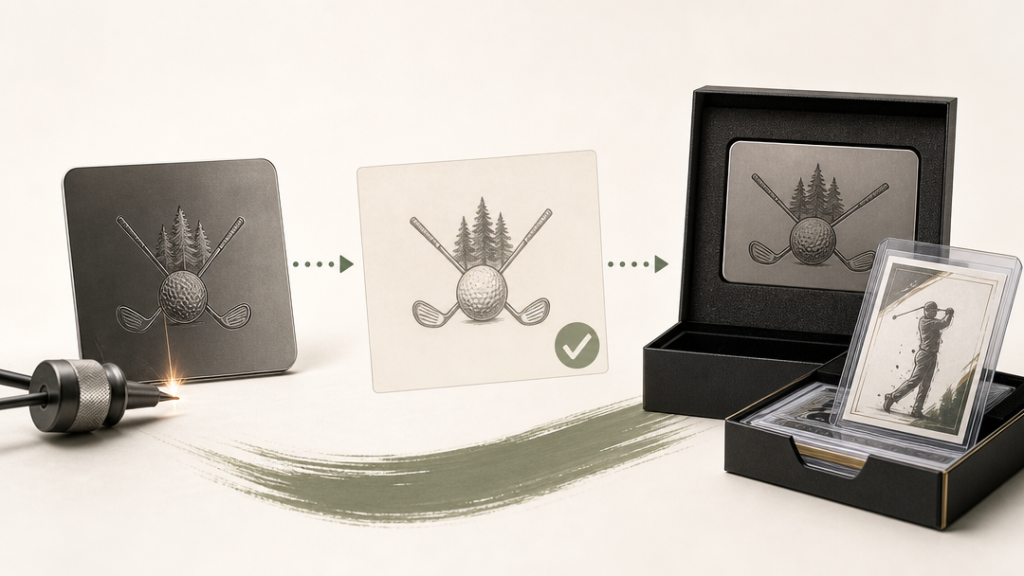
JRCustoms presents laser engraving and golf card breaking, while the available commerce record adds a sharper business question: when an item is personalized, can a simple proof-confirmation handoff reduce uncertainty before the customer commits?
Commerce performance: an audience snapshot is not a purchase signal
Followers
3,196Follower snapshotVideo units sold
0Rolling 90 daysProducts promoted
23Rolling 90 daysReported video sales
$0Rolling 90 daysJRCustoms has an audience snapshot of 3,196, but the source-reported rolling window records 0 and $0. That contrast matters because a follower count describes accounts connected to the profile, whereas attributed purchase activity shows whether the available commerce measurement recorded attributed sales through creator video commerce.
Here, it does not show purchase activity in that channel during the reported window.
The same overview lists 23 as promoted products. That is useful evidence of breadth in the recorded promotion overview, not evidence that every item sold, appeared in a particular video, or contributed equally to the reported result. Taken together, the record supports a restrained commercial conclusion: audience presence and a broad promoted-product set do not by themselves establish a repeatable buying path.
For another creator, this makes the handoff from interest to order the important question. A custom offer especially needs clarity about what the buyer is approving, when production begins, and what happens if the requested details are wrong.
A custom order needs a visible approval moment
A useful hypothesis for creators selling personalized work is that the buying experience should include a clear proof-confirmation step before production. This is not a claim about what JRCustoms currently does; it is a practice another creator could test.
Imagine a customer requesting a personalized engraved item. The seller could send one concise proof containing the exact spelling, the selected design version, and the scope of what will be produced.
The message might say: “Please check the name ‘Maya Chen,’ confirm design B, and reply ‘Approved’ for one engraved item.” The seller would then treat that reply as the handoff into production, rather than relying on an informal message such as “looks good.”
The value of this workflow is not a promised increase in sales. It makes the decision legible to both sides. The buyer can catch a misspelled name or an unwanted layout. The seller can distinguish a request for changes from approval. The customer-facing explanation should also state what is included and what is outside the agreed scope, using plain language rather than assuming the buyer understands production terms.
Your next step with VIKOC
Give your next idea a place to sell.
Create a VIKOC account, then start setting up your own storefront. Use the lessons here to make your offer clear to customers.
Already have an account? You can sign in on the next page.
Turn the proof into part of the offer explanation
A second hypothesis is that creators can make this operational step easier to understand by showing it as part of the product journey. A short explanation could present three stages: submit the personalization details, review the proof, then approve production.
The example should identify the fields that matter most—spelling, design version, quantity or other agreed scope—while keeping the design-approval step separate from any payment or order status.
This also gives the creator a practical way to learn where uncertainty appears. If buyers repeatedly ask whether they can change the design, whether punctuation is preserved, or whether the proof covers the full request, those questions can become clearer shop language and future explanatory content. They should be treated as questions to investigate, not as evidence of an inventory or sourcing problem.
For a creator with several kinds of promoted products, keeping the confirmation language specific to the selected item may be more useful than presenting a general promise of “custom work.” The test is whether customers can understand the commitment they are making without an extended back-and-forth. Any benefit remains a hypothesis until measured.
Test one proof-confirmation flow before expanding the offer
Try the workflow on a small set of hypothetical personalized orders or live inquiries: show the customer a written proof with the exact spelling, design version, and production scope, then ask for an explicit “Approved” response before treating the request as ready. Keep the wording and proof format consistent for the test period.
Record how many people ask for clarification, request a revision, approve the proof, or stop responding. Also note which field causes the most questions and how long it takes to reach a clear decision. Compare those responses with inquiries handled using the existing explanation, if one is available. If buyers reach approval with fewer clarification loops, make the proof step a standard part of the offer explanation.
If confusion remains concentrated around one field, revise that field and test again before adding more product variety or promotional complexity.
About the data
Sales and promoted products cover the recorded rolling 90-day period; followers are a separate snapshot. Sales are source-reported, not independently audited or creator earnings. USD uses the confirmed default where source currency is missing. No usable video link accompanies this archived sample; no video content analysis was used.
Archived, source-reported commerce observations are used alongside a separate follower snapshot. Sales are not creator earnings, profit or audited settled payments; units are not unique buyers. USD follows the recorded currency default. Promoted-product counts do not identify the products responsible for sales. The aggregate sales value per unit is not a typical price or order value.
Profile descriptions are self-reported, and product claims have not been independently verified. Available media supplies context only; missing images or videos have not been reconstructed, and no video-content analysis was used. Recommendations are proposed tests, not explanations of this creator’s results. No endorsement or partnership is implied.
- Followers: 3,196
- Point-in-time snapshot. Captured 2026-11-06 06:05:46-08.
- Video units sold: 0
- Source-labelled rolling 90 days. Captured 2026-11-06 06:05:46-08.
- Products promoted: 23
- Source-labelled rolling 90 days. Captured 2026-11-06 06:05:46-08.
- Reported video sales: $0
- Source-labelled rolling 90 days. Captured 2026-11-06 06:05:46-08.
Updated November 10, 2026. Independent analysis; no creator endorsement implied.
Request a correction or removal


David A.
0 comment