
The short answer
Compare Stan Store and VIKOC against your actual offer types, delivery tasks, audience journey and account requirements. Use current official documentation and account-level tests. Record the plan, market and date checked rather than declaring a universal winner or relying on an outdated price.
Write your requirements first
First, check your offer types. Do you need digital downloads, a structured course, coaching appointments, or custom services? Stan supports digital products, courses, and bookings.
VIKOC also supports digital offers and service-focused storefronts. Imagine a language tutor choosing a platform. The tutor needs a worksheet download and a way to present one-on-one lessons.
Another creator might need a full course and a recurring membership. Their priorities are different, so a generic winner is not useful. Make a short checklist of the exact offer types, delivery tasks, and buyer journey you need.
Separate essentials from optional features before comparing screenshots or reacting to a long marketing feature list.
Compare documented capabilities
Second, look at how people will reach your store. Are you mainly sharing one profile link, or do you need to organize supported video-to-offer connections? Test the actual journey on mobile.
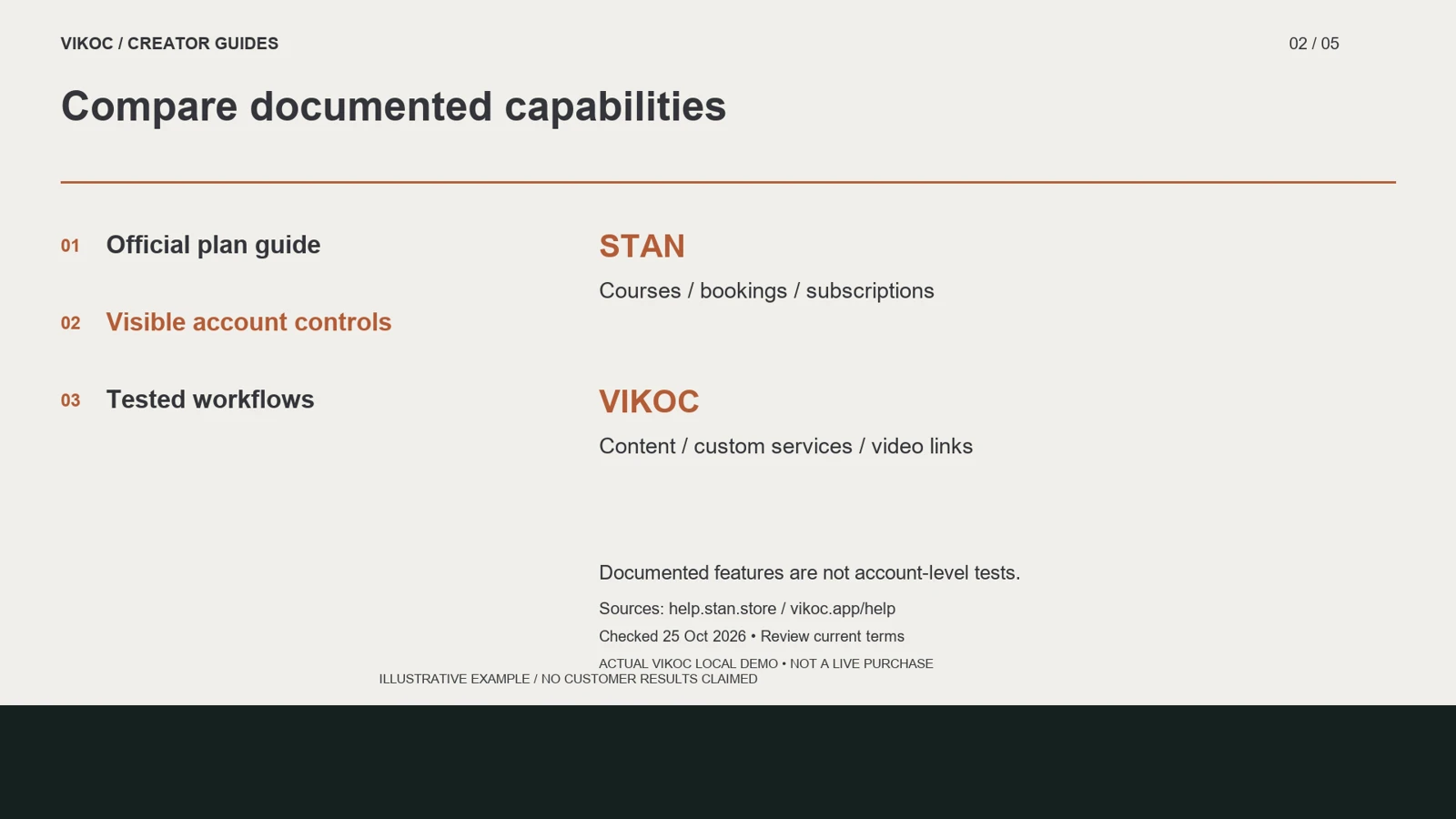
Stan’s official plan guide lists tools including courses, calendar bookings, and subscriptions, with additional marketing tools in its higher plan. Review the official descriptions for the plan you would actually buy. VIKOC’s creator workspace provides separate content and service paths, and its help describes supported video-to-offer connections.
A documented feature is not proof that your specific account, country, or product setup is ready. Test the relevant workflow instead of turning a feature name into an unsupported guarantee.
Check costs and payment eligibility
Third, compare the current plan, transaction terms, payment availability, and delivery workflow for your own country and account. Don't assume two platforms work identically everywhere. Read the current subscription and transaction terms directly on each platform.
Include the payment provider’s availability in your country and the process for receiving funds. This tutorial does not quote a fixed price comparison because terms and account conditions can change. Write down the plan, market, date checked, and source for any comparison you make.
If a term is unclear, mark it as unverified and ask the provider rather than filling the gap with a favorable assumption.
Use a comparison worksheet
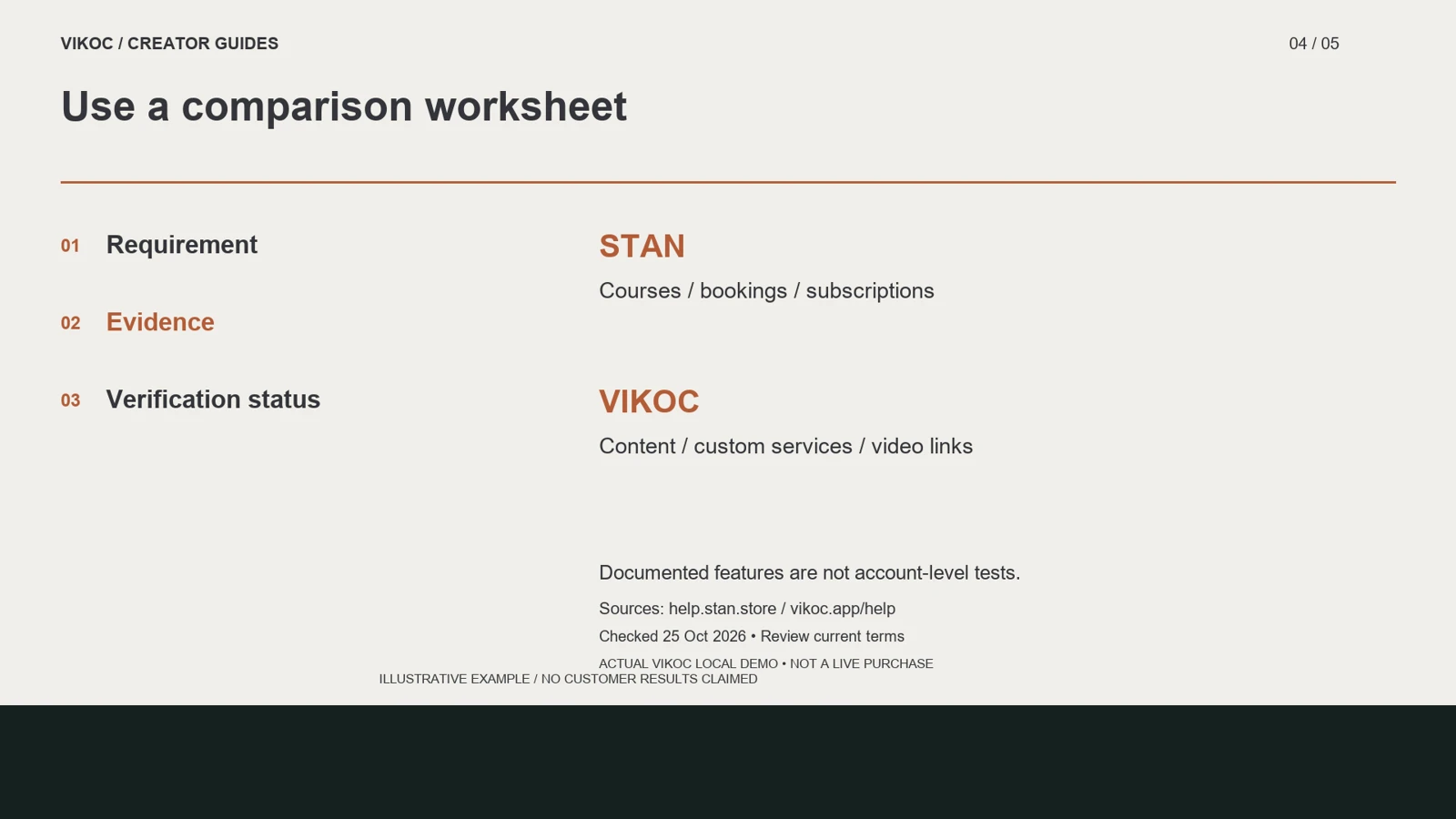
Make one row for each essential task and two columns for the platforms. In a third column, record the evidence: an official help page, a visible account control, or a completed test. Those are not equivalent, so label them.
Add the plan, market, and date checked when they matter. A feature with no account-level test can remain documented but untested. For example, reading about calendar tools does not show that your own timezone and availability are configured correctly.
This approach keeps the comparison useful even when you do not quote prices. It also prevents a blank field from becoming an unsupported claim that a competitor lacks a capability. Resolve the important unknowns before making your choice.
Try the buyer and creator tasks
Compare practical tasks: creating the offer, presenting the files, sharing the public page, and checking what the buyer receives. Inspect the mobile journey and any supported booking process. A profile link and an on-platform video connection are not automatically equivalent.
Keep official feature descriptions separate from workflows you personally tested. The point is not to declare one product universally better; it is to identify the platform that fits your offers and operating requirements. Recheck material terms before committing to a plan.
Try it with one real offer
Make a worksheet with essential tasks, each platform’s documented capability and your test evidence. Add plan, country and date where relevant. Mark unknowns instead of treating missing evidence as a missing feature.
Common questions
Does a listed feature prove my own account is ready?
No. Documentation describes a capability; a configured account and an actual workflow test provide different evidence. Verify the parts your offer depends on before choosing a plan.
How should I verify this in my own VIKOC account?
Compare the available controls with the offer you intend to deliver. Review the public destination as a visitor and record which setup, payment or delivery steps were actually tested. A local demonstration is not proof of a completed customer transaction.
Official references
Reviewed 25 October 2026. Account eligibility and terms can change; verify the current documentation and your own configuration.