The short answer
The best place to sell digital products depends on your audience source, required delivery workflow, total operating cost and need for brand control. Compare those requirements with verified platform capabilities instead of choosing a universal winner.
Publisher note: This guide is produced by VIKOC. Comparison details were checked against official documentation on October 22, 2026. Eligibility, plans and integrations can change; verify the terms for your account before choosing.
Question one: Where will buyers find you?
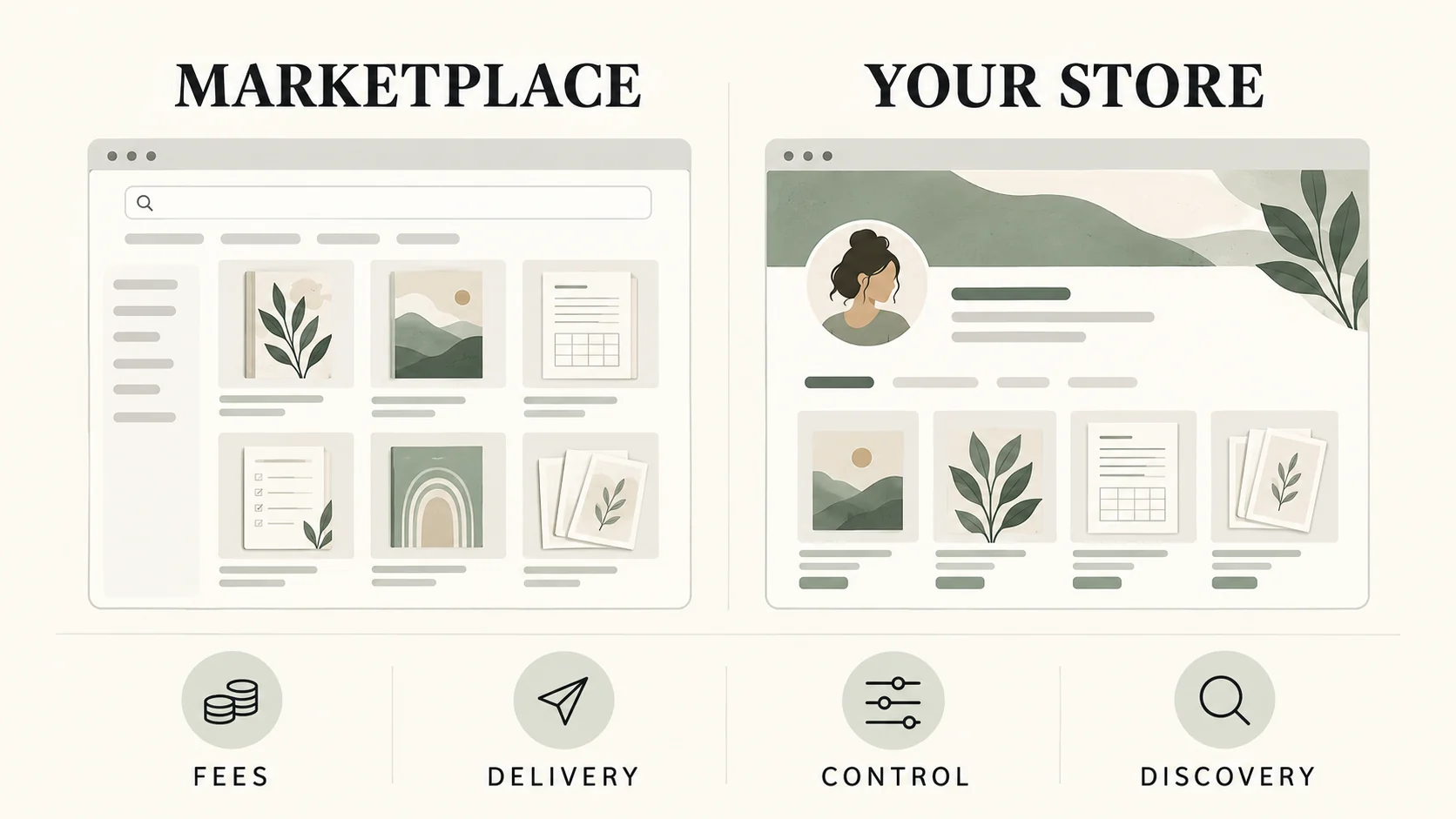
Start with the source of demand. If buyers already search a marketplace for products like yours, that marketplace may be worth testing. If people discover your work through your videos, newsletter, or professional network, a focused store can give them a place to evaluate your offer.
Neither route guarantees customers. Marketplace listings still need relevant products and clear presentation. A separate store still needs a way to attract visitors.
Write down the first realistic path by which someone will find your product.
Question two: What are you delivering?
A downloadable PDF, a recorded course, and a custom design service do not have the same requirements. A PDF needs a dependable file delivery path. A course may need lessons and access controls.
A custom service needs customer questions, a defined deliverable, and communication about the work. List the required steps before looking at a feature checklist. In VIKOC, digital products and custom services have distinct creation forms.
Verify the exact workflow you need on every platform you consider.
Question three: What is the full cost?
Compare total operating cost using the same assumptions. Include a subscription if one applies, listing and transaction fees, payment processing, optional apps, and any paid tools your workflow requires. A low headline price does not answer the whole question.
Keep the billing period and currency consistent, and separate a temporary promotion from the normal price. Use the platform's current official pricing and the rates available to your country. This decision tree deliberately avoids treating one universal price as correct for every creator.
Question four: Can you run the complete workflow?
Now run one small practical test. Prepare a sample product, create a draft listing, inspect it on a phone, and check the documented delivery route. Confirm seller eligibility and available payment methods before committing to a platform.
A beautiful preview does not prove that your own account can accept payments. Keep a short note of missing steps and extra tools. If a required step cannot be verified, treat it as an open question rather than giving the platform a passing score.
Apply the tree to a real example
Consider a designer selling a café poster pack to people who already watch her design videos. She needs clear previews, file descriptions, and a direct destination that matches her content. A creator store is a reasonable candidate to test.
Now consider someone whose plan depends on shoppers browsing a marketplace. That person should evaluate marketplace discovery and competition as part of the decision. The product could be identical, but the acquisition plan is different.
That is why a single best-platform answer can be misleading.
Make a shortlist, not a permanent promise
Reduce your shortlist to two platforms and compare the same product on each. Use three labels: verified, needs another tool, and not yet checked. Do not score an untested payment or delivery feature as if it worked.
Choose the option that meets your essential needs with a manageable operating burden. VIKOC can be one candidate in that process. The useful outcome is a defensible choice for your business, not a claim that any one platform wins every category.
Use a requirement checklist
| Requirement | What to verify |
|---|---|
| Payments | Seller eligibility, supported methods and applicable processor fees |
| Delivery | The purchased file or service reaches the customer as promised |
| Operating cost | Subscription, required apps, transaction charges and maintenance |
| Discovery | A realistic source of relevant visitors, not assumed traffic |
Try it with one real offer
Use the same product and copy to compare two selling options. Record payment eligibility, delivery method, fees, maintenance effort and where visitors will come from. Mark every untested requirement as an open question.
Common questions
Is a marketplace always better for a beginner?
A marketplace may provide product discovery, but competition, policies and costs still matter. Your own store can suit an existing audience, but you must also plan how visitors find it.
What costs belong in the comparison?
Separate subscriptions, listing or transaction charges, payment processing, necessary add-ons and operating time. Confirm the billing period and regional terms.
Continue with a related task
- Etsy vs Your Own Store: Where Should You Sell Digital Products?
- Stan Store vs VIKOC: Which Creator Store Fits You?